Saturday, June 15, 2013

Pre Race

Well here we go again. The nerves are setting with thoughts about tomorrow's Half Marathon in Barrie dominating my mind. This time there is a bit of a different feeling after looking at the field and noticing that I have a good chance of winning the event. Of course, not recognizing any names in the field doesn't necessarily mean that it is an automatic win. In fact, in long distance races there is no such thing as absolute or predictable. That is one of the quirks about this type of event, it is so unpredictable. In the buildup to a race, you try to make running at race pace as comfortable as possible, but any runner knows your feel and comfort level from one run to next changes almost as often as the weather as of recently.

And on that note, tomorrow is supposed to be a nasty one. The temperature will be comfortable at 16, but there is a 90% chance of showers (10mm) and some chance of thunderstorms. But, the weather will not discourage me from running as hard and fast as possible. The reason, I will never miss a day of training or workout because of poor weather, is because I always say if it happens on race day I know I can handle it. However with the field, and the possibility of poor weather I hope to PB, but I don't necessarily expect to as I did going into Mississauga. That being said, every wednesday before a race I do a key workout called a pyramid where I run 200m, 400m, 600, 800, 1000, 800, 600, 400, then 200 with only 200m in between each interval. It is a great high intensity workout that totals about 14k with warmup and cooldown and 5k high intensity work. Anyways, this Wednesday I ran the fastest intervals I ever have run since started to do this workout about 8 months ago. The 200s were done at 2:50/km pace, 400s at 2:53/km, the 600s at 3:01/km, the 800s at 3:04/km, and the 1k in 3:03. All of this times are on anywhere from 10-a whole 15 seconds faster per/km pace than doing it before mississauga. Throughout the race I will imagine myself on the track at St.Es running this workout and hopefully that will allow me to push through the inevitable tough stretches. Another quirk about the half or full marathon is that unlike races like the 3000 or 1500, which I ran in high school, you know before you even start that there will be some stretches of the race where you need to grind and battle. Anyways, before I start I will keep the Kenyan saying in my mind to boost my confidence, "Train hard, win easy."

One last note this will be the swan song for my now decorated and remarkable adizero adios. Its been a great spring season let's end it with a bang.

Thursday, May 30, 2013

Gear Review and Quick Training Update

The relationship between me and saucony started by chance. In October of last year I bought my Garmin Forerunner 410 full price. About 2 weeks later, I saw my sparkling new device in the running room magazine, for about 100 dollars cheaper. So I ran back to the running room, showed the manager the magazine, and he gave me a 100$ credit to be used in the store. Now at this point I was in kind of a limbo with my shoes. Coming off the 2012 Scotiabank Marathon my training shoes were making their slow transition into retirement, and I had actually started to use my adidas adios 2.0 racing flats for the bulk of my training, I was even throwing in my brooks launch into the mix. I knew I would use the money to buy new shoes, however I don't really like the style of shoes sold at the running room - too many nimbus', kayanos' (my least fav - useless technology with all that gel), etc.

I did see that the store sold saucony kinvara 3s. The lightweight trainer which can be used for racing as well, and it seemed like the perfect shoe to buy. However, the only reason I hadn't bought the shoes before was because reviews showed the durability on the shoes to be questionable at best. But no other shoe caught my eye so I thought why not give them a try - it's "free" money anyways. Well, 3 pairs of saucony kinvara 3 now retired, you can say I like the shoes alot. For me they last about 600 kilometers (which is pretty good considering their weight). April came along and I had seen on Saucony's site that on May 1st the Kinvara 4s would come out in Canada. So I got my money ready, and planned out my Kinvara 3s 3rd generation to last exactly to that date. Unfortunately, May 18 came along and still no stores in Canada sold the shoes. The next day at work, I checked just for kicks the running room site and finally the shoes were there. I went to the store after work bought them, and went for a 30 kilometer long run. Over 270 kilometers of running later the shoes feel great. They feel a little less springy than the 3s, but they seem to offer alot more structure while actually being lighter, all thanks to the new powergrid base. They really help promote that midfoot strike, and the fit is like a sock. The flexfilm provides a great fit, and the tongue/lace portion feels light and breathable.

You can see the lowered heel and the new PowerGrid. 
 Also some much needed adjustments that saucony made was lowering the heel to counter irritation to the achilles tendon that the 3s caused, and moved some of the flexfilm which caused irritation near the pinky toe. Thanks to the new foam, the durability seems to have improved (won't know for sure yet) since the sole seems to be relatively intact still - keep in mind in the sizzling hot summer that I can feel approaching the shoes will simply not last as long compared to the spring or winter (running on top of snow). Overall, love the shoes. 

My shins feel great, knee are good, achilles is good, and im ready to take on the Barrie half. Tues, and Thurs are my really big training days where I will bike to york for my 1.5 hour aqua fitness class, bike back home, go on a 25k or so interval style run, and immediately after go for a 65+ kilometer bike ride, then do some honest ab work. Today, I pushed myself harder than ever and pushed my body's limits thanks to the heat - feeling like 37 w/ the humidex. I don't like to carry water on my runs, and today I could have used it. When I came back in from the run I was 8lbs lighter. Not to worry thanks to litres and litres of water I'm okay. With the amount of water I gulped down right after I legitimately started to worry about hypoatremia - if you down know what that is it is basically when you drink water in excess of your kidney's filtering capacity (about 10L) which throws off your serum sodium levels and can be fatal. Anyways, love to hear some comments about your favorite shoes, or even how you stay hydrated on big training days. OO ya, and one more thing Ryan Hall is back to racing. He ran the Bay to Breakers 12km finishing second with a time of 35:40! He then ran the Gatorade Half Marathon in Costa Rica a week later and won by more than four minutes over second place with a time of 1:04:09. Ya sure, it's not quite the 59:43 he ran in Houston in 2007, but keep in mind the weak field therefore there was no one really there to push him. Plus he showed some rust by going out too fast (set a PR of 7:54 over the first 3k) and faded on the back stretch because of it. But still, good to see him back, and I can't wait to see which fall full marathon he chooses - maybe NYC? 

Thursday, May 9, 2013

Training Smart

Being a kine student and someone who is always looking for new training workouts to improve my running, I thought it would be interesting to talk a little about training and to critique a sample training schedule that Garmin's new Training Plan system suggested for a Half Marathoner. The idea of having these kinds of training plans is great since they provide beginners with some direction, and more advanced runners new tips and tricks to throw into their current regime. I find these plans to be more beneficial to beginners as it seems as though many people don't really understand what goes into a build-up for a race. I often get questions from others like how far do you run everyday, or what is your running pace. To those of you who do train you would know that these questioned can't really be answered as you simply don't run the same distance everyday, and almost every run has a different purpose and therefore a different pace. I stress the word train because I feel people fall into two different categories those who run, and those who train. This may seem like an arrogant comment, however, think about it: an individual whose goal is to get into shape and improve there fitness will have a completely different approach than someone looking to win a race or shave a few seconds off of a personal best.
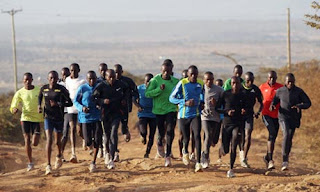
Look at the amount of runners on this long run in Iten, Kenya
amazing to think probably 95% of this group can run sub 2:10. 
For those looking to start road racing a training program has a few key elements. The two most important elements to your 16-week build-up are the tempo run and the long run (btw - I am speaking to those training for 10k and above as a 1500m or 3000m may have a different setup to their program). Before we even get to these two critical workouts, runners should go through a base-building phase. For beginners this phase may last 4-6 months, eventually building to about 70km per week of easy running. Basically this phase looks to increase an individuals overall endurance and allow there body to make the necessary aerobic adaptations like: increase mitochondria size/density, increasing oxidatize enzymes concentration, increasing capillarization in muscle beds, etc.

Then onto the training phase. While training for a marathon or half-marathon you are not only training for the race itself, but you are training to be able to withstand the training week 3-4 weeks out from the race where you will log the most mileage both on the long run and a long tempo run. I'm not going to take you thru each and every week and run throughout the 16-week, but basically I look to have a goal and purpose to each and every run during the week. For me, I run 6-days a week (every now and then I'll run all 7-days if I'm feeling good). I do a long run on Sunday's typically anywhere between 28km and up to 34km. This year if I decide to do the full in October I will look to get my long run up to 37km. I will do a tempo run on wednesday's this varies from 14km-18km when training for a half marathon, and 19-24km for a full marathon. Some time in the week I will do what I call a pickup run where I will run around 20-24km will about 12-15 200 meters faster than race pace surges (so if race pace for my half is a 3:25 kilometer than these 200 meters will be done around 3:15) with 800 meters rest in between. Usually on Friday's I will do a track specific workout (these start later into the 16-week build-up) where I will do a pyramid, or 400s, or mile repeats. Also somewhere in the week I will do a strength orientated run with bunches of hills. The other two runs (if a seven day week) are easy runs at a steady pace usually about 45-1min slower than race pace. The reason the tempo run and long run are the two most important runs of any training program are because the two main keys to having a successful race are to be able to last for the duration of the race (the  long run's purpose), and to make race pace feel more comfortable (the tempo run's purpose). For the long run a few points I
My favorite runner Ryan Hall out on a 12 mile tempo.
need to stress: for a full marathon make the duration of the long run your goal time for the race. For example, if your goal is to run a 3 hour marathon than your long run should last 3 hours - you won't be running the same distance because you are running slower but you are trying to get your body and more importantly your mind prepared for the race. Many people on training runs often say they let there mind wander and pass the time looking at the scenery and thinking about what's for dinner (this is called dissociation), however at a high intensity like in a race you need to associate into every one of your body's feelings, and for me I am conscious of each and every footstrike. The fact is this can be mentally draining, and therefore you must prepare for it in training. Here is a sample taken from the Garmin Training Plan System - this is week 10 in a 16 week buildup to a half-marathon for advanced runner.


Here's my critique on there suggested program. Firstly, Day 3 seems like a rest day - don't know any advanced runner with two rest day's in there week. I say this because a elite runner will be cross training in some way most days of the week - whether it is biking, swimming, elliptical, strength training, etc. Second, the week in missing one of the key elements and that is the tempo run. Instead, the program suggests doing two intervals sessions during the week. While intervals are effective at making race pace feel more comfortable you need to be able to sustain that effort for the entire race and 1km repeats will simply not achieve that. My main issue from the program is that it has the individual on those interval days doing the intervals in the evening after the morning recovery run. To me this makes no sense on a number of fronts. First, in the morning I'm not quite sure what the individual is recovering from exactly. The recovery run should be after the hard session to help loosen up the legs, and help clear the system of the lactic acid that built up during the intervals. Second, if you are doing a speed session wouldn't it make more sense to do that session in the morning as all races occurs in the morning. When doing tempo runs or speed sessions you should try to make the conditions as close to the race conditions as possible - this means wearing the outfit you intend to race in, the shoes, and obviously running at approximately the same time. One small side-note adding up the times it is only about 7 hours of training in the week. Again never heard of any elite runner or any athlete from any sport for that matter training only 7 hours per week - even if this person averages around 4:00min/km that is only about 100km for the week or should I say weak.

 Week 10
Day 1
 
Rest
 
Rest day.
Day 2
 
W10D2a-Recovery Run
 
• Morning run.
• Run, recovery pace, 30 minutes.
• Cool down, 5 to 10 minutes.
• Stretch.
Day 2
 
W10D2b-Intervals
 
• Evening run.
• Warm up, 15 minutes.
• Run, threshold pace, 15 minutes.
• Run, 10K pace, 1K. Jog, recovery pace, 90 seconds. Repeat 4 times.
• Run, threshold pace, 15 minutes.
• Cool down, 5 to 10 minutes.
• Stretch.
Day 3
 
W10D3a-Recovery Run
 
• Run, recovery pace, 30 minutes.
• Cool down, 5 to 10 minutes.
• Full stretch.
Day 3
 
W10D3b-Cross Train
 
Cross train, 30 minutes. Focus on upper body and core. Stretch.
Day 4
 
W10D4-Hills
 
• Run, 45 minutes. Push 4 to 5 hills to 90% effort.
• Cool down, 5 to 10 minutes.
• Stretch.
Day 5
 
W10D5-Recovery Run
 
• Run, recovery pace, 40 minutes.
• Cool down, 5 to 10 minutes.
• Stretch.
Day 6
 
W10D6a-Recovery Run
 
• Morning run.
• Run, recovery pace, 30 minutes.
• Cool down, 5 to 10 minutes.
• Stretch.
Day 6
 
W10D6b-Intervals
 
• Evening run.
• Warm up, 10 minutes.
• Run, threshold pace, 10 minutes.
• Run, 10K pace, 1K. Jog, recovery pace, 90 seconds. Repeat 3 times.
• Run, threshold pace, 10 minutes.
• Cool down, 5 to 10 minutes.
• Stretch.
Day 7
 
W10D7-Long Run
 
• Run, easy pace, 100 minutes.
• Cool down, 5 to 10 minutes.
• Stretch.

Sunday, May 5, 2013

Post Mississauga Report

Just like the week or so leading up to the Run for Retina Half Marathon, going into today's Recharge for Milk Half Marathon there was a lot of uncertainty. Although I been lucky this year to set a new personal best in every race i've competed in I have also had to battle a lot of pesky overuse injuries - maybe there is a correlation between all the training to get the pbs and the injuries...Anyways even with injuries from Achilles tendinitis (which as of about thurs of this week started to heal thanks to alot of eccentric calf raises) and a reemergence of my old tibia issues in my left and right legs, I was able to achieve the time I set out to meet in my Post Around the Bay Post from March of sub 1:12:30. Honestly leading into this week I looked back on my post from March and thought setting that goal was probably too ambitious. Right now it hasn't really set in yet, I'm still in a bit of a state of shock that  I actually did it. 

So the day started at 4:40am with a good long (15 min or so) hot shower which I always do, not only to wake me up but to have some time to go over my race plan, and obviously to just warm up my muscles. Had my typical oatmeal and a banana along with a coffee. Now for those of you reading (for the few I should say) if your just starting out running or triathlon or whatever endurance event - practice your nutrition in training. Some say coffee is a diuretic (dehydates you) but actually just so you know only very high doses of caffeine would have that effect - studies show 600-700mg of caffeine will produce this effect (about 6 cups of coffee). But, its whatever works for you - for me if I don't drink coffee at breakfast I will feel sick and get a bad headache (happened once this year when I accidentily slept it and had to flat out run to the bus to make it for class - worst day ever). I guess you could say I'm addicted but its not really to the feeling from the caffeine - sounds strange but I find even just holding a cup of hot coffee in my hands to be relaxing plus I love the taste. Wow - now that I've wasted your time going off on that long tangent - back to the day. Got to the race at about 6:30 and  the race started at 730. I did a big long warmup of running As, Bs, etc. Before the race there was a moment of silence for the victims and all those affected by the Boston Marathon bombings. 7:30 the gun sounded and we were off. Started the race so fast getting to the 5k mark at 16:48. When I saw the digital clock on the side of the road I thought to myself, "easy there big fella, this is a recipe for disaster" - so clearly so good ole positive self talk. Mostly during these race I have a constant conversation going with myself: my legs are screaming, "What are you doing to me man this is nonsense" my  mind saying back "Aww this is nothing suck it up." The mind won this battle because I got to the 10k mark at 33:30 so a 16:42 5k split. At 10.5 this is a huge hill so me speed slowed a bit there but I pushed though and the fatigue by just increasing my stride frequency - since when you fatigue you tend to start over-striding. At 15k was at 50:54 (so 17:24 5k split) and this is the point where I start doing some math in my head of what time I'm on pace for - surprisingly these simple calculations can be very difficult while running at top speed, almost like you forget how to add. 20k at 1:08:07 (17:13 5k split), and 21.1 kilometers the half marathon distance in 1:11:53 - these are values from my garmin and it calculated the route to be 21.28 km - in which case my finishing time was officially 1:12:22 for 4th overall. I will update with some pics soon. 

So up next is the Barrie Half Marathon June 16th. For this one I would say my goal is sub 1:12 but I think this will be very difficult. Not necessarily because I'm not capable of it but because last year the winner was in at 1:19 which means I will likely (unless there are different competitors this year) be the one responsible for setting the early pace instead of at mississauga where in the beggining I'm being pulled along by runners like Lucas McAneney - a great runner out of Toronto who came second in time of 1:06:55 and couple years ago was top Canadian in the Ottawa Marathon. I hope my achilles injury is behind me and my tibias heal up - think I'm going to start take a real ice bath a couple times a week. One more thing the next price increase for the Scotiabank Toronto Waterront Marathon is May 27 and I still don't know what to do. If there are any other runners (or anyone) I would love to hear your opinion of whether I should make another go at the full - maybe run sub 2:30 (obivously you are going to slow down through the second half but I think I am more than capable of a 1:5 half marathon average) - or keep trying to improve on my half time.  

Sunday, April 21, 2013

Running on Empty

Recently I came across an article on the Running Times Nutrition website about one of Meb Keflezighi's (Olympic Marathoner - Team USA) training tactics. He calls in running on empty. Basically, when your body is completely glycogen depleted and then perform a high intensity session research (Keith Baar Ph.D study which can be found in the European Journal of Sports Science) has shown improvements in your body's ability to burn fat thereby sparing glycogen stores. It also can help you mentally since it can get you accustomed to running with very little energy (which will happen regardless of your training methods at the end of a marathon). I just came back from a depleted double, where I skipped CHO throughout the day then played 60 minutes of floor hockey (lots of sprints and quick burst, plus I didn't take any shifts off), then right after skipped refueling (I did rehydrate - just with water), and then went on a 20k tempo run (1:11:30 - was just ripping up the road thanks to my achilles feeling somewhat better probably 75%). Anyways, I feel like a zombie right now but we'll see in Mississauga if this workout today pays off.

Tuesday, April 16, 2013

Post-Race

As you know this weekend I competed in the Run for Retina Half Marathon. If you read my last post you would have seen I was fearing the unknown due to a few injuries - especially my achilles tendonitis  - that had crept up earlier in the week. In fact, between Wednesday morning's run and the 9:15am race start on the Sunday I had not run due to the injury. Although I was doing other things like biking and swimming to keep myself somewhat relaxed and to keep my muscles from turning into sludge, three whole days off running. That is the longest break from running I have had since June 1st of last year when I take about 9 days off running due to a flare up of my reoccurring shin problems (stress fracture). Going into this race I had thought there were not going to be many fast runners however a few runners from the University of Western Cross Country Team showed up. I asked one before the race what time they were aiming for and the guy said that a few weeks ago in the Chilly Half in Burlington he ran 1:10 - gulp!


Getting ready to go and feeling very nervous.
The gun suddenly went and we were off. The adrenaline seemed to help some of the pain - but I'm not going to say I was pain free as I was clearly favoring that leg and running with a bit of a limp. Surprisingly at about 0.5k I was in the lead for about 2 minutes when the two guys from Western passed me. I tried to stay with them for as long as I could but I knew that the pace was too ambitious for myself so I settled down and let them go - however I did manage to keep them in sight. It wasn't advertised this way but the course was actually very hilly and after the first big one I lost sight of the two leaders. Felt odd during the race since there was about a 1:30 gap between me and the two leaders who were working together (teammates at western) and a 1:30 gap between me and the rest of the runners. So I was largely running on my own for the entire race. Some might say that it is never a good thing to be on your own during a race, but I don't mind it since that's how I do all my training and I am more than capable of pushing myself. At around 14 kilometers the leader dropped out (he went too fast at the start) - and I'm not going to lie, it inspired me to push harder. I closed the gap between myself and the leader to where he was about 40 seconds or so ago but unfortunately I just couldn't find that next gear to catch him. Still, I crushed my previous record for the half and ran a 1:13:56 for second overall. I was shocked that I was able to run that speed in a fair amount of pain - luckily afterwards the prize money and complementary massage made my leg feel a little better. 
Btw to clarify the lady there is in the 10k - so shes not beating me

So onto the mississauga half marathon in 2 and half weeks (May 5) hopefully I can beat this achilles injury before then, and manage to get a couple quality speed sessions along with a few LSD runs. If I manage to do that I don't see why on the largely flat course of Mississauga I can't go sub 1:13 or faster. If my training keeps progressing at this pace I think it may be time to start thinking about taking it to the next level finding a coach, and seeing what I am really capable of accomplishing in the half. 


Friday, April 12, 2013

Pre Race Report

Thought I would take a quick break from studying for a few minutes to write a quick post. This weekend I am competing in the Run for Retina Half Marathon. Due to flooding in the area the race start was moved from Harris Park to Storybook Park. I am really hoping that the new half marathon course is certified 21.1 not 21.8 or something like that. I remember last year at the Oakville Half Marathon where the course was a whole 650 meters long. For some people this may not be a big deal but to those of us racing against our own time and not necessarily our competitors (like myself) it is a huge problem. I means about 2 minutes added onto your time. When looking back on the race it appears as though my time from the Mississauga Half in the spring last year and the oakville in september got worse. This may not seem like an issue now because I know the course was longer so it doesn't mean anything, but that's the point: that it doesn't mean anything and takes away from all the hard work you put into training and prepared for the race. When I step up to the starting line, after paying my 60 or 70 or sometimes over 125 dollars for a race I expect the race to be 100% accurate, in addition to a number of other components which make a race enjoyable and worth the price.
Just to rant for a minute or so, I feel the registration fees for road races, and triathlons is getting out of control. Just last month, I was looking for a local 5k race to tune my skills before going to the Around the Bay. I came across a race called the Achilles St. Patrick's Day 5k which was held downtown Toronto, but I chose not to sign up because it would have cost me near 60 dollars to register, plus parking and other fees. Do the math, if I was to run a 16 minute or so 5k (not really sure what my time would be since I've never ran a 5k race)  I am paying over 4$ per minute to run. Being a kine student, I am always being taught the benefits of physical activity, and about the obesity epidemic spreading across North America with more than 68% of the population being inactive and considered overweight. With childhood obesity rates skyrocketing, and the baby-boom cohort which is largely inactive one can only wonder what are we doing wrong as a society to promote physical activity. O, let me take a quick guess, maybe its because of greedy race coordinators, gym owners, and community fitness centres charging an arm and a leg to participate. One other example just this week I went to the Dufferin Clarke Commuity Centre website to see what it would cost me to have year-round access to the pool. For 50 visits it would cost a person my age 200 dollars and 300 dollars for the year (not to mention the fact that length swim is unavailable on weekends? and only available 3 days a week for 8-9:30). If we want people to get up a move for a change, how about we making physical activity a little more accessible to the  public. If I was a parent on a strict budget it would seem like a no brainer -"For 300 dollars my kid can either swim a couple times a week for a year or so, or for that same 300 dollars I could buy him (just hypothetically) a ps3 with 3 games and multiple controllers to invite his friends over a play for the next 5-10years." Wow that's a tough one.
Just to report on my pre race status a few weeks ago I was looking foward to this race to set a new PR in the half. Unfortunately, I think a PR would be a long shot as my training has hit a bit of a set back. On Sunday evening after my hockey game, I went for a easy 27k run, but over the last couple kilometers (which is all uphill) I started to feel a minor ache in my left achilles tendon. Monday morning i got up and was experiencing an excruciating pain in the tendon, and hobbled around the house. Pretty sure it nothing too serious just a resurfacing of achilles tendonitis which I got last year 2 weeks out from my STW Marathon in October. To make matters a bit worse favoring my right leg on my runs on Tues and Wed has now caused some pain in my right tibia to come back (a injury I've been dealing with on and off for the last 18 months since the 2011 STW Marathon). But to keep things positive, I know from last year's marathon that I am more than capable of running through pain (some may say I am an expert in it) and come Sunday I will line up at the starting line ready to go (and hoping the race is the right distance). If I spend the next couple of days worrying about the pain, odds are it will surface come race-day. Think positively, and as Bob Marley says, "Don'y Worry about a thing, cause every little thing is going to be alright."