Friday, January 17, 2014

Nutrition in Sport Series #2

So before I started this series I was thinking about introducing topics like glutamine supplementation, beta alanine, and other pretty sophisticated supplements that many people probably haven't heard much about before. But I'm thinking in order to really help other runners (and the general public) alter their own daily nutrition practices for the better, I should discuss topics that are particularly relevant to what they are already consuming on a daily basis. For this reason my topic for this post will be on protein, and how supplementation timing, amount, and type can aid your performance. Again for this post I will focus on endurance athletes, even though as you can imagine protein supplementation is vital to strength based athletes as well, but most of the info can be applied to both. (Note: If you want me to discuss supplements like beta-alanine, glutamine, L-carnitine, and others, please leave a comment below because I can speak on those as well at length).

The word protein is derived from Greek word proteos which means "primary" or "to take place first." It is the nitrogen-containing part of food that is critical to life as it is involved is a wide array of roles within the human body such as being structural components, contractile filaments for muscle (actin-myosin), antibodies for our immune systems, transport vehicles in the blood such as those for iron (transferrin), hormones, enzymes, and more. Proteins are composed of amino acids, and only 20 amino acids are genetically coded from mRNA. Out of these 20, humans are unable to synthesize eight amino acids therefore we must consume them via dietary proteins, termed essential amino acids. Depending on the conditions in the body some of the non-essential amino acids (meaning those that our body can make) can become essential amino acids.
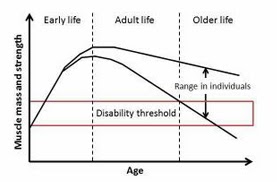
The net rate of protein synthesis and degradation is collectively known as protein turnover. The maintenance of muscle mass in the body is a balance between protein synthesis and muscle protein breakdown. As endurance athletes we want to maximize this balance in favor of  synthesis and this is done by exercise and protein ingestion. The processes behind the adaptations such as translation, gene transcription, etc., are too complex and not necessary to the purpose of the post. While a lot of papers focus on positive protein balance being beneficial to resistance trained athletes, it is reasonable to speculate that a positive protein balance would also aid endurance athletes by increasing mitochondrial protein synthesis/volume (which is the cell organelle responsible for aerobic respiration, hence more mitochondria higher VO2 max, better performance). One study has shown that post-endurance exercise supplementation with protein resulted in greater improvements in peak oxygen uptake
compared to carbohydrate supplementation post-exercise. Basically if protein supply is in close
proximity to endurance exercise better adaptation, better subsequent performance. However, having said that, an overwhelming gap is apparent in the research regarding protein supplementation and endurance athletes, research is heavily focused on the resistance athlete. Although, one could argue that understanding resistance exercise is more vital than aerobic exercise due to it being especially important to our aging population (baby-boom cohort) to help fend off sarcopenia (loss of muscle mass), and maintain muscle coordination to avoid falls. So basically I understand why the research is so slanted towards resistance exercise.
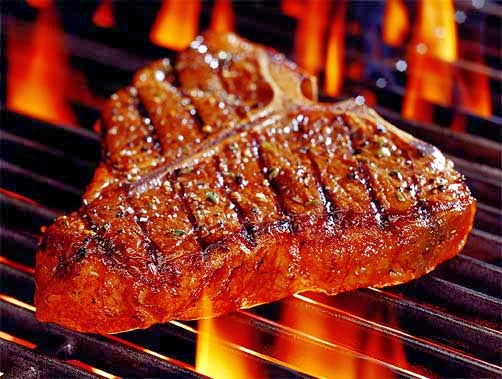
Now to the real information about how much protein to consume post-exercise, when to consume it, and what type. I will start which the amount. According to the US Dietary Reference Intake (DRI) individuals over the age of 19 should aim to consume 0.8 g of protein/kg body weight per day. Living in North America, most of our diets exceed this value astronomically due to the high intake of meat. Some figures show that in the North America individuals consume about double the DRI. For reference, a 8 oz. sirloin steak has approximately 60 grams of protein, a small (3.5 oz.) chicken breast has 30 g, and a 5 oz salmon fillet has about 45 g. So just imagine, if you consume a piece of steak for dinner, assuming your around 150 lbs, you have already surpassed your protein requirements for the day. Having said all that, athletes need a greater amount of protein to facilitate the volume of training. A number of studies such as Tarnopolsky et al. (1993) from McMaster University cite that endurance athletes need to consume more protein than 0.8 g/kg BW to supplement the increased amount of leucine oxidation that occurs during exercise. The data varies on the optimal amount but most suggestions falls between athletes consuming 1.2-1.4 g/kg BW per day. In terms of how much athletes should look to consume following a bout of exercise to maximize muscle protein synthesis, a protein dose-response relationship was shown to exist by Moore et al. 2009 (who is at UofT and presented his research to my nutrition aids class). In the study, the authors showed that muscle protein synthesis increased as protein was increased from 0-20 g following a bout of exercise, however, when the athletes consumed 40 g there was no increase. This indicates that at these high protein intakes the excess amino acids were oxidized. So the consensus is that around following a exercise bout athletes should try to consume 20-25 g of high-quality protein.

What do I mean by high-quality protein? As you probably already know there are a number of different sources we can get protein from our diets. For example, we get protein from animal sources like milk (casein and whey), eggs, meat, plant sources like soy, etc. Such protein sources are graded on the
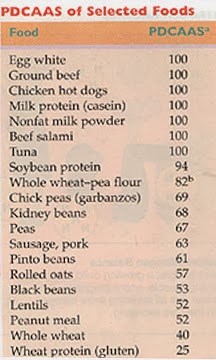
"Protein Digestibility Corrected Amino Acid Score" which evaluates a protein's quality based on the amino acid requirements and our ability to digest the protein (ranges 0-1). For example wheat protein (gluten) achieves a score of only 0.25. Why? Well because it lacks a couple amino acids, and it is not as digestible. This is why vegetarians need to combine plant protein foods that have different complementary amino acids to yield a complete protein (or just have quinoa since it is a complete protein). In comparison, animal proteins such as eggs, milk, and meat score a perfect 1.0 of the scale meaning they are very high quality proteins. Soy protein is also a very high quality protein. So after a run or workout you want to look to consume 20-25g of milk protein (whey/casein) or soy protein. Just for reference straight up milk is about 80% casein protein and 20% whey. Having said this, these three proteins (casein, whey, and soy) differ in there digestion rate. Casein for example clots in the stomach and is very slowly digested, compared to whey protein which is rapidly digested (soy is somewhere in the middle). So for an endurance athlete in terms of which source to consume after a workout, I would say that largely depends on the workout schedule for the day. For example, if your doing a double workout soon after the first, I wouldn't recommend having lots a casein protein as that may cause some GI problems during the second workout since it takes so long to digest. In that case, whey protein would be the best. However, if you are running late at night, maybe something high in casein would be better since your muscles can "munch" on that casein protein all night long. Overall, most studies have shown milk protein is superior to soy protein.

This flows nicely into my next point on the timing of protein consumption. Often you hear athletes in the gym say they need to quickly get home, or to the store to buy some chocolate milk right away since they believe firmly in something called the "anabolic window." Many people believe that if they don't get there protein shake within a certain time limit (an hour) after the workout than the whole workout is wasted. Even in commercials such as the chocolate milk one, recommend you consume the product within 20 minutes of working out. Well, the fact is this is not backed by any reliable scientific research. In fact just one example of many, Reasmussen et al. found there was no significant difference in leg net amino acid balance when whey protein was ingested 1 versus 3 hours post-exercise. So don't worry about having to shower and stretch as quickly as possible to get in your protein, your muscles are not going to fall apart.

To put everything together, you've finished a 2 hour run and your done your exercise for the day. What do you do? Consume 20-25g of high quality (milk or soy, preferably milk protein) sometime after the run, and don't worry if it's a couple hours afterwards. Seems simple right...But I will throw in a caveat to that. If you are a endurance athlete consuming more 3, 4, or 5000 calories a day, do you really need to go buy a jar of whey protein isolate. Probably not. The fact is based on the number of calories you are putting in everyday you are most likely already getting 1.2-1.4 g of protein/kg of body weight per day. So the simple way to get in your 20-25 g post-workout is just to consume that through you post workout mixed meal, and not necessarily an expensive protein rich shake - and absolutely not Booster Juice, the biggest waste of money ever. Also, you could just have some skim milk after the workout - lots of protein plus lactose sugar which will help replenish glycogen stores if that workout was longer than 2 hours. Overall, the fact is that if you are consuming the typical North American diet, high in
I think this graph from study of UofWashington is pretty amazing.
As Canadians we consume 94.3 kg of meat per person per year -
that is over 200 lbs. 
meat, and then adding on protein shakes you are probably consuming an excess amount of protein per day already which offers no benefits and may actually pose health risks. For example, overconsumption of protein can increase calcium excretion leading to bone loss, and has been implicated in kidney stones, heart disease, and more. For heart disease though it is difficult to say that the high protein is solely responsible for this since high protein sources like meat also tend to be high in saturated fats. However, if you are a vegetarian like myself and eating crazy (and I mean crazy probably 80-90% of my daily calories) amount of carbohydrates for meals like bread, pasta, cereal, oatmeal, etc. having a protein supplement is probably a good idea since those CHO sources like I mentioned before score pretty low on the PDAACS. Sure I could just consume things like edamame, nuts, beans, eggs, etc. to get my protein, but doing right now 3, 4, or 5 workouts a day means that the convenience of the protein supplement makes the most sense. For example, the other day getting up early doing a workout on the trainer, then right after hitting the roads for a 18k run with 6 800m repeats in there, then a high-intensity core workout, having to get showered and dressed as quickly as possible to get to classes, then come home 5k snowshoe, and then one last workout on the bike trainer, having a scoop of protein powder in between there seems the most convenient versus having to cook up an omelette. By scoop, I mean just a scoop of tri-source (whey, casein, and soy protein) powder in a glass of water, or the new milk-to-go sport which I found is also really good has 25 g of protein plus lots of calcium, zero fat, very low sodium.

One last thing, just for fun (maybe I'm the only one who thinks its fun/interesting) track how much protein you are consuming per day and correct it to your body weight (g of protein/body weight in kilograms). I bet most of you would be shocked to see how much protein you are actually already getting. Make sure you take into account all the protein you are eating not just the protein from the steak at dinner. For example, if in the morning you put a couple of Tbsp of peanut butter on toast, that is 6g of protein plus about 8 g from the toast (14g total). Overall, become more conscious of what you are eating, and look for areas you can improve. Because if you eat right your body will repay you with high performance. In other words, Fuel the fire.

References

Phillips SM, Van Loon LJ. Dietary Protein for athletes: from requirements to optimum adaptation. JSS 2011; 29: S29-S38.

Stark M, Lukaszuk J, Prawitz A, Salacinski A. Protein timing and its effects on muscular hypertrophy and strength in individuals engaged in weight training. JISSN 2012;9:54


Monday, December 30, 2013

Nutrition in Sports Series #1

Finally, done exams, and able to start what I have been planning to do for a while now: create a sport nutrition series where I will introduce you to some of the most recent findings endurance sports nutrition. The first topic will be caffeine as an ergogenic aid.  I'm only going to focus on caffeine in endurance sport even though it has been well documented that it can improve performance in strength, anaerobic, and reaction time based sports.

Caffeine is commonly considered the most consumed drug in the world. The history of its use in endurance sport is not new, as it has been studied extensively since 1939. Physiologically, ca
ffeine can act in numerous ways in the body, however, the only practical mode of action, within normal physiological concentrations, is through inhibiting adenosine receptors. These receptors are found within the brain, heart, skeletal muscle, and adipocytes (fat cells), so caffeine can influence the body in a wide variety of ways. Not going to go in a lot of detail of this, but for example, the A1 isoform of the adenosine receptor has biological actions of decreasing heart rate, so inhibiting it would serve to increase cardiac output. Also caffeine can stimulate certain brain areas like the adrenal medulla to cause adrenaline (epinephrine) to be released. The release of epi. mobilizes free fatty acids which may result in muscle glycogen sparing. However, findings on whether caffeine enhances FFA metabolism is not convincing. One study found that caffeine failed to alter the rate of FFA or glycerol (a product of triglyceride breakdown) appearance into the blood. In another, caffeine enhanced FFA levels, but failed to enhance FFA uptake into the working muscle. Currently, the theory is that caffeine enhances AI receptors of adipocytes causing lipolysis which then elevate FFA levels in the blood, followed by uptake of the FFA by the liver for oxidation, or to form ketone bodies to be cleared by skeletal muscle. Does this cause glycogen sparing? Initially, studies form that caffeine supplementation resulted in less glycogen use during prolonged exercise. Although, current research shows that this effect is minimal after the intial 3-15 minutes of exercise. Furthermore, research from the last two decades fails to show that caffeine can decrease RER, shifting the energy balance to fat oxidation over carbohydrate oxidation, prolonging time to exhaustion. So how does caffeine work to improve performance? Well studies have shown that many aspects of fatigue during endurance exercise involve a loss of electrolyte homeostasis - particularly a loss of potassium from the sarcoplasmic reticulum. This will result is less motor unit activation and force production. One study showed that by increasing epinephrine, caffeine supplementation worked to increase skeletal muscle ATPase activity and therefore more potassium in the cell, and greater muscle contractibility. Finally, the main way it has been suggested that caffeine supplementation affects performance is via A1 inhibition in the CNS which "stimulates the brain" (reducing the rating of perceived exertion, perceived pain, and increasing levels of vigor). This is of course an oversimplification, however, for the purposes of the review, which is to simply introduce the topic at hand and give a suggested protocol for optimal performance, it is not necessary to go further into.

So there are many theories as to how caffeine works in the body, but really, when it comes down to it, who cares how it is working biologically, what about performance. Jentkins et al. showed that caffeine increased work output during a 15 cycling TT by 4%. Cox et al. showed that caffeine supplementation provided a 3% improvement in a 2 h cycling trial followed by a 30 min TT. Ivy et al. showing across a variety of doses caffeine improved total work by 7% during a 2 hr cycling trial. Running? Wiles et al. showing a significant improvement in mean time during a 1500 m race on a treadmill with caffeine supplementation. Overall a meta-analysis by Ganio et al. reviewed 21 studies and showed on average caffeine ingestion improved performance by 3.2%. Now, that may not seem like a whole lot, however, in elite sport, 3.2% can be the difference between 1st and 10th. For example, if Wilson Kipsang the current marathon world record holder improved his 2:03:23 by 3.2% he would run under a 2 hour marathon.

So what's the proper dosage and timing? Most studies show that caffeine is rapidly absorbed and reaches peak plasma concentrations after approximately 1 hour. This is why most studies have protocols whereby subjects ingest a dose o caffeine rest an hour, and then exercise. While caffeine's effects "kick in" quickly, it has a long half-life and maintains high plasma concentration for 3 to 4 hours post-ingestion. Most studies use a dose of caffeine indexed for body mass, though some studies still for some reason use an absolute dose of caffeine which results in smaller body weight individuals like women to have much greater doses than men relative to their mass. One study, showed that anywhere from 3 to 9 mg/kg of caffeine had an ergogenic effect on performance. A subsequent study showed that when ingested with carbohydrate 2.1 mg/kg of caffeine was enough to improve performance, however, it appears that a dose of 3-6 mg/kg is optimal. To put this into perspective a large coffee at Tim Hortons is 140 mg of caffeine, and a grande at Starbucks is 330 mg of caffeine. So if your say 80 kg (about 175 lbs) than you need a little less than a grande at Starbucks (a tall is perfect), and a it will take a whole lot of Tim Hortons coffee. In terms of the dosing protocol, no study has compared a single pre-exercise dose to repeated doses. However, I believe that since the half-life of caffeine is 4-6 hours, and since exercise does not impair or influence caffeine's absorption, than a repeated dose in an event longer than 6 hours may be beneficial to prolong the effects. Otherwise, in events less than 6 hours one dose before the event is adequate. No studies have looked into caffeine's effects on ultra endurance events.

So what's the best strategy? For optimal endurance performance aim to ingest 3-6 mg/kg approximately one hour before the event, or, if you experience gastrointestinal discomfort with large doses of caffeine than take smaller repeated doses throughout the exercise bout. Also, studies have shown habitual caffeine users (coffee drinkers) are less responsive to the effects of caffeine - there is less of of increase in adrenaline following ingestion. The reason being that chronic caffeine consumption results in an up-regulation of the adenosine receptors within the CNS meaning a greater amount of caffeine is needed to elicit the same effects. Therefore, using a time to exhaustion protocol, one study showed that time to exhaustion was improved when subjects abstained from caffeine for 4 days compared to zero. In animal studies, it has been shown that adenosine receptor affinity was maximized after 7 days abstaining from caffeine consumption. Therefore, athletes should abstain from caffeine consumption no fewer than 7 days prior to the competition, and then have the 3-6 mg/kg of caffeine an hour before the event. This should allow enough time for withdrawal symptoms (like headaches, lethargy, flu-like symptoms) to subside. If the withdrawal symptoms are too much to handle, habitual caffeine users may just consume a larger dose of caffeine than usual before the event to experience the same ergogenic effect.

Last but not least, some people think that caffeine is a diuretic, but this is a myth. A diuretic is something that causes the body to lose more water than usual. Basically, some believe that caffeinated drinks can potential dehydrate individuals, so much that British Olympic teams have discouraged their athletes from consuming coffee, tea, etc., at competitions. Tell that to Mo Farah, who won double-gold in the 5000m and 10000m, and in an interview about what he did immediately before the race said he drank two espressos and a coffee twenty minutes before the race. In one commonly cited study advocating that caffeine has a diuretic effect, the subjects only increased urine output after they, who were regular coffee users, avoided coffee for 4 days and then drank 642 mg of a caffeinated drink - that is 5 large tim hortons coffees. Overall studies have shown that caffeine only has a diuretic effect in very high doses. Also taking a single dose of caffeine before the event like suggested in the prescribed protocol has no diuretic effect, and habitual coffee users become accustomed to its effects and therefore the diuretic effect is diminished.  

In conclusion, caffeine is a powerful and easily available ergogenic aid that consistently improve endurance performance, and has no negative effect on fluid balance. To put a little more emphasis on the 3.2% improvement documented with caffeine, just think if you are a 4 hour marathon runner having a coffee before your next marathon can shave more than 8 minutes off your time. That could easily be the difference in qualifying for boston or not, winning your age category, etc. Let's face it, if you go to any athlete and I say I can help you improve your performance without doing anything illegal and without increasing the amount of training, would you take it. Plus, it's not like I'm saying start drinking awful tasting spinach shakes, or buying expensive supplements, just brew a cup of great tasting coffee, and sip on it an hour before your race, feeling the energy fill your body and the soothing feeling of the warm mug in your hands.

References

Maughan RJ, Griffin J. Caffeine ingestion and fluid balance: a review. J Hum Nutri Dietit; 16:411-420.

Burke LM. Caffeine and sports performance. Appl Physiol;33:1319-1334.

Graham TE. Caffeine and Exercise: Metabolism, Endurance, and Performance. Sports Med;31:785-807.

Ganio MS, Klau JF, Casa DJ, Armstrong LE, Maresh CM. Effect of caffeine on sport-specific endurance performance: a systematic review. J Str Condi Res;23:315-324.


Friday, November 15, 2013

Post Race

Finally get a chance to update my blog, and give a report on the Casablanca 8k from last weekend. So as you know I was using this race merely to put some energy back into my legs, and kind of forget about STWM. Even though I will never forget my performance on that perfect day, the race will help me start to look forwards instead of continuing to look back. So the day started pretty early, but not crazy early, since the race had a nice sophisticated 10 am start time. Got there just after 9, so I was able to get a real good warmup in on what was looking like a brisk day. Throughout the skips, and strides back an fourth thoughts about this hollowing wind started to creep in. That south wind that was forecast was even more pronounced than I thought since we were right along lake ontario - Side Note: If I lived in Grimsby, I would run here all the time - just a beautiful back drop with the water, it looked like there was even a trail right by it, and boy the course was flat as a pancake (If I wasn't windy I bet you could just fly on this road). So got up to the line I asked one competitor what time he was going for, he told me with a straight face, "well 8k is not my distance I am a 7k runner." I laughed to myself, well okay maybe a little chuckle outloud as I responded, "Okay, well what time do you normally run a 7k in." He said, "Under 21 min." Again I chuckled a bit to myself, as I looked at his reebok cross fit shoes and knee length shorts - ya I labelled him. Then some more serious looking competition took the line. I've said in the past the problem with some of these smaller shorter races, and why I have essentially given up checking the confirmation list before I go, is because you frequently get these speedy track/XC runners looking for a fast workout and signing up the day of of just before. In this case, three runners from etibicoke track club toed the line, one guy said he was aiming for 26 min and hey that was what I was aiming for, so decided he (Jake) was my rabbit - later found out that he ran in the New Balance Indoor National Championships running a 3:50 or so 1500m - some real speed in those legs.

Gun sounded and we were off, first k was awesome I sat back of the three track runners perfectly shielding myself from the harsh winds, and running probably the easiest 3:08 kilometer of all time. Also at this point reebok superstar over there, dropped off like a stone. We started N into the park cruising along in nice organized 4 person line, literrally almost hitting each others feet as we strided along. I stayed in second place because I wanted to be able to try and react quick enough if the leader tried to push it or not - Remember it is only an 8k race so one bad move or lack of move and there is no time to make a comeback. And as I suspected the leader (Jake) took off and I responded sticking on his heels (we are running 3:16-3:17 at this point - on nice tightly pack gravel). And now it was just me and Jake, him leading, me sticking in behind. At 5k though was the TSN turning point. As we started heading south back to the finish, we were met but a fierce wind. Jake slowed down to a crawl pace - 3:34 - I looked at my watch and I thought this would destroy my time, so I got real aggressive and took the lead over for myself - and I may as well have handed the other guy the winning medal right then and there. He tucked in behind me, I knew I made a mistake, and his coach from the bike on the side told his athlete, "okay just stay in there that's good." Almost like I needed another voice telling me what a bad mistake I just made, because my inner voice screaming at myself in my head saying "you stupid, stupid, idiot" wasn't enough. Well as my inner voice and I suspected my legs got absolutely gased by the effort into the wind, slowed to a 3:26 and then 3:30 kilometer. About 1 mile to go, Jake cruised passed me. For a brief moment I pulled back to his heel, but couldn't stay there, the snap and pop of my legs was gone. Although Jake beat me with 26:52 and I rolled into finish in second place with 27:07 (as I mentioned with the wind this was not going to be an incredibly fast race - just averaging 3:22/km), I think If I had two more kilometers I could have comeback to win. This is based on the fact that I was actually gaining a bit on Jake by the end, and after the race he was huntched over clutching his knees and looked absolutely spent. I came in and was more upset at both myself and the announcer saying the wrong name as I crossed the line than tired - since remember this was my average pace for the half marathon in may, sure this was a harder effort cause of that wind but overall given a kilometer or so I was recovered and could keep going.

Like I mentioned in my last post, I look to learn something from every race. In this one especially there is lots to learn. Firstly, the mistake was not just taking over the lead to get killed by the wind, the mistake happened even before that. It was when I looked at my watch and saw 3:34, panicked about my time, and then decided to take the lead. The lesson is that you have to commit to either winning the race or to running your goal time. Sometimes you just can't do both. If I said I didn't care about my time and just continued to stay in behind Jake, then blast the last few hundred meters, I would've had a much better chance of winning. If time was my goal, than I did the right thing since if I stayed behind Jake and let him do all the work our time would've be in the high 27s, since he had slowed to 3:34, and when I took the lead I brought in back to 3:26. Now having said that, its not to say that if I committed to winning the race and stuck in behind Jake I would have certainly won, because as I mentioned before this is a track runner with close to 4 min/mile speed and a damn good 800m time. So perhaps if I waited until the final 400m to get going, Jake most likely would have the advantage in a 400m foot race. The second lesson, is about goal setting. During the race, seeing 3:34 briefly on my watch set me into a furry because I thought this would destroy my chance of getting my time that I set before the race. And I am not saying that having a specific time goal is wrong, because having specific goals that are measurable is a key aspect of goal setting. For example, If I said before the marathon my goal is to run hard that's not specific or measurable. There is no meter on the side calculating how hard your running, so when you cross the line how do you know if you accomplished the goal or not - could you have gone harder. In contrast, having a time goal is very specific and measurable so it is an effective motivational tool, in that you will know if you achieve the goal or not. Having said that, although specificity is important, goals also have to be adjustable and realistic. Road running is markedly different than say running the 5000 m in a closed stadium on the track. In road running, conditions can play a huge role in your time. For instance if you run say a 31 minute 10k on a exceptionally flat course is it realistic to think you will run the same 31 minutes on a course that has lots of hills? Of course not. Just like, if you run 3:07 and 3:08s on the track with no wind the Thurs. before the race, it is not realistic to think that is possible on a windy day out on the road. As much as setting these time goal is important, I have to learn how to adapt and adjust to the conditions of the course layout and the weather on any given day. And I think that skill will take time and practice. For example, I'm not entirely sure how much time a windy day will add to my pace because I haven't raced in those condition enough yet. Based on this race I can maybe estimate that the wind will add about 7 seconds per kilometer during a 8k. So during a marathon that may equate to something around 5 minutes.

So that's it for the 2013 season. Right now the my training is going well. The goal is to get in at least 2 speed workouts a week, one being a tempo run, and one intervals on the track. For now the intervals are not marathon specific ones like 3x4miles (6.4k) or 10-12x1mile, I'm just trying to work on pure leg speed with shorter ones like 200m/400m repeats. The other day I did a good one alternating 400m/200m 9 times with only 30 sec active recovery in between each. Also I'm currently doing quite a bit of strength work, really trying to strengthen my rhomboids to pull my shoulder blades back a bit. In terms, of mileage this week will be a little over 100k, will stay at that next week as well, and then will try to spend about 2 weeks at 120-130 just building my base mileage for the year. By Christmas I probably be back around 160k. Time to go out for what else another run - first of 3 exercise bouts on the day, friday's will be my day of two-a-days and will bike in between. In other news, my green adios went out on a 9k tempo run on wednesday, the legend lives on.

Friday, November 8, 2013

Refocusing and Rebuilding

After my performance at the STWM which was the grand finale to my 2013 season, it is difficult to refocus and mentally prepare for the next season. I was looking at some of my stats from the 2013 season and since Jan 1st of 2013 until the end of October 2013 (10 months) I ran more than 6000 km, climbed more than 35000m (4 times up mount everest), burned more than 500,000 kcal (just to put some perspective 3500 kcal is 1 pound of pure fat, so 500000/3500 = 143 lbs of energy used), and between running, strength training, and cycling more than 700 hours. With such big numbers it's hard to get myself mentally prepared to do it again next year, and with even more kilometers and effort. Because when it comes down to it the goal is to improve week to week, month to month, and ultimately year to year. In 2012 my biggest running week was  145 kilometers, in 2013 my biggest was 230 kilometers. That is a 58% increase! What impact did that have on performance 2:52 marathon --> 2:34, a 10.5% improvement. Another 10% is a 2:18 marathon, 14.8% would mean Olympics. So how do I get that. Well it won't take one year, not two, not three, but the beauty is I'm 21 yrs old - if I can gain 2% per year math says 7.5 years from now - oh my goodness look at that, that is the year of the 2020 Summer Olympics in Tokyo.

 Nice to dream about the future, but for now the only way to get there is to make it my goal to improve every week, and be better tomorrow than I am today. That starts with re-energizing my legs and my drive for winter base-building by racing tomorrow in the Casablanca 8k. The only unfortunate part about the whole thing is I was so excited to try out a new racing flat-the Nike Lunarspider R3, all 5.6 ounces of it, all of it fast. Living here just north of Toronto, you would think you could access anything you
needed or ever wanted. But no, running stores in Canada don't sell any true racing flats, and now running warehouse has basically stopped shipping to Canada. Must be too difficult to ship to us living here in igloos in the tundra or something. Plus, Saucony Canada is a joke, for God sakes update your site, the cortana 2s are like 2 years old, I wear to cortana3s yet according to their site they are not out yet. Nike, don't get me started, so much flash, sure it looks really pretty, yet try navigating through it quickly and I doesn't look so pretty with loading circles spinning endlessly. Whatever I'll stop ranting, looks like I'll be wearing my marathon racing flats (adios 2.0). I could wear my interval/10k flats the adidas hagio 2.0 but they are currently in palliative care. Just making sure the transition to shoe heaven is painless. In terms of the gameplan for the race,  pretty simple - run fast and maybe try to have some fun along the way. Last night was a great high-intensity average about 3:07 per kilometer on loose gravel track for 7 x 1km repeats (HR got to 191). Now I'm not expecting to go 3:07 per k for 8k but I would be content going 3:13-3:14 for something around 26 minutes. But that be said I'm not going to put to much pressure on myself, the goal here is not to set a world record or anything its just to get myself pumped up for the long winter haul. Conditions or tomorrow look to be okay, but it will be interesting. The temp. looks good 6 degrees feeling like 2, but the interesting part is the 33km S wind. Now you are never going directly N or S, you start going WNW, then NEN, then turnaround to SWS, and back ENE. So yo are always on an angle to the wind, which I have never raced in before, but like I mentioned a couple posts ago, I try to learn something for every race so I can improve for the next one. So until next time, as the kenyans say train hard, win easy.

Friday, October 25, 2013

2014 Can't Come Fast Enough

This morning I've been doing a lot of research and planning for my 2014 racing season. Although it has only been 5 days since the marathon, I find putting some events on the calender will help me to re-focus my training once I begin running again on Monday. I never like just running aimlessly with no future goal to train towards - because even though the Scotiabank Marathon was a big thing for the year it is only a stepping stone to bigger and better things in my running career. Also, stuff has to be put on the calender soon for what I'm planning to do in 2014 to help me periodize my training. First off to help me "ease" back in training and get some energy back into my legs I am competing in the Casablanca 8k on Nov 9. Honestly, I wasn't sure if I should do the race or not because a part of me thinks wow it has been such a long season, but another part thinks this will be a great way to kick-start my training. In other words, I am not treating this race as a way to end off my 2013 season, it ended with STWM, but rather it is a way to start my training leading into the 2014 season. In addition, I feel I still have this fire burning inside and wanting to race again sooner rather than later. You might think taking a full week off in light of a race coming up in 2 weeks is a little odd, but honestly after STWM I think I could jog my way to a 3:15-20/km avg for a measly 8k - Okay maybe not jog but you know what I mean.

In terms of the gamplan for next year here is a tentative schedule I've made up for the first few months of the season.

Feb 16/17: Either the Winterman Half Marathon or Grimsby Half Marathon

I think each one has its advantages. For the Winterman it would be fun to go to Ottawa again and see if I could defend my title. Being a repeat-winner just has a Tiger Woods kind of feel - and sounds bad ass. However, the disadvantage of the race would be I know the course and remember it is a looped type which means I have to go around people as I lap them - wasting time, and waste even more time having to go around them when the course narrows to a sidewalk for a couple hundred meters (last year I had to bound over and onto the snowbank to get around some people. So essentially, I think my time in Grimsby might be faster, and not to mention less expensive compared to going all the way to Ottawa. Although that week is reading week, so getting there and back doesn't have to be too rushed.

March 2: Chilly Half Marathon - Burlington

I want to do this one because seeing last year's results there are some wicked fast runners who competed in it. Lionel Sanders won it last year in 1:07 and 5 guys total under 1:12. So I think it would serve as a good indicator for the new seasons' time goals (which I will discuss in a bit).

March 30 - Around the Bay 30k

After last year's incredibly well organized and great race/route setup (love the challenge of starting out pretty flat and fast route then changing to rolling hills followed by the biggest hill on the Ontario Road Racing Circuit at 26k) this one is a definite. Also, this year that race was by far my biggest help to setting my time goals in the marathon. Here is a excel sheet I made up in the week leading to last weekend's marathon.
10 15 20 25 30 35 42.2
0:35:43 0:53:47 1:11:55 1:30:27 1:48:26 2:07:00 2:34:00
0:03:34 0:03:35 0:03:36 0:03:37 0:03:37 0:03:38 0:03:39

The non-bolded text are my splits for the around the bay. In the bold are what I was planning to hit in the Marathon simply continuing from the 30k mark on. I used this on the race to know if I was ahead or behind pace. In the race though I actually got to 30k in 1:46:15 and to 35 in 2:05:32 - this is why I knew I was 1:30 ahead of schedule. 

Apr 20 - Toronto Yonge Street 10k 

Not entirely sure what date this one is, so this one is really tentative, although if not this one I will find another 10k on that weekend. Having said that I would really like to do this one because the downhill course would let me run a really fast time.

May 5 - Mississauga Half Marathon

This will be the fourth time competing in this race - third time in the half. I like the course - mostly because my half PB in 2012 was here, and my half PB in 2013 was here. So historically I perform well here. 

May 25: Ottawa Race Weekend - Marathon

Ya I said Marathon. In the upcoming year I think I am ready to do two major marathons, after doing 2 in my first season, and it chewing my body up and spitting it out. This time around though I got lots of miles built up into my legs and I can survive the two major builds better. Sure a person will never be able to say they are used to running 200k+ a week because it is so physically demanding on the body, but I can say I have experience with it and think I can handle it for two periods in the year. Amazing though how on this week off I can see how demanding that training regime was. For example, during this week if I am running late for class I can just bolt across campus, bounding up stairs to get there. During my build up to STWM I could not bound up stairs or sprint across campus because my legs and feet were just physically exhausted from the day before or the run that morning. 

So that's what I got planned for the spring. In terms of my time goals I will set those a little later once I've maybe completed my first couple workouts/tempo runs. What I can say is that it will be fast. For example, in the Marathon I got to the halfway just over 1:13, only 40 seconds slower than my half marathon PB, so I think that time is not only going down it will be smashed. I'm thinking in the 1:10 range. For the 30k I know that time of 1:48:26 is going down since I passed the 30k mark in the marathon in 1:46:15. Meaning that one is going down a bunch. In the full marathon, I don't know yet since its obviously too early after I just completed one. So at this moment it is hard to see myself going faster since I gave that race my all. That being said I know I can still improve, and after my first couple half's I will set a time.

Monday, October 21, 2013

Revenge is Sweet

So as you all know yesterday was the Scotiabank Toronto Waterfront Marathon. I have been waiting for this day for the last 12 months since last year's race. I'm not going to say last year was a failure because I simply started too fast, rather it was doomed to begin with, since I went into the race without much of a gameplan. This year however, was totally different. I started the season buying a Garmin Forerunner 410, which it will sound weird, but literally revolutionized my training regime. To that point I was running with nothing but a stopwatch. I would judge my pace purely by feel, since not only could I not know the current pace but also I would have no clue how far I was into the run. The watch changed my training from going by feel, to becoming systematic and precise. I was able to effectively go on a variety of runs, and complete so many different workouts that I never before could really do accurately and therefore properly. I progressed with my training and looked to sharpen my skills while racing. In high school cross country, and my first few marathons I had no real plan, and not much experience to race competitively. This season I started in the Winterman Half in Ottawa, where I learned how to lead from the front and push the pace myself. I led start to finish dismantling my competition by five and a half minutes. From there, my drive to race only increase and I figured the more I raced the better I would become purely from having different experiences each time I toed the line. I moved quickly on to the 30k in Hamilton, where for the first time I experienced feeding off of another competitor. I ran neck and neck with one competitor for the first 25k of the race and then, building on my previous experience in Ottawa, took control of the pace myself leaving my competitor in the dust up the dreaded hill at 26k. From there I went to London to compete in a smaller half marathon, beat my PB set only 2 months earlier in Ottawa, by learning how to ignore pain, running the race with a bad case of tendonitis. Throughout my training in the lead up to Mississauga I learned many new workouts to gain speed, and it paid off once again smashing my PB set the month before. From there to Barrie, where I once again got to experience the feeling of winning, setting a course record, and learning how to race in any weather with heavy legs. Next, to Dundas where I used pure speed workouts and countless lactate threshold workouts to push my speed limits and challenge a Kenyan for the first time in a race. The feeling a coming so close to winning left me even more determined to improve. On to, St. Catherines where once again I came close to winning, and where I experienced the feeling of running on truly bruised and battered legs. Not only from nagging injuries, but also the sheer volume of mileage.

And then, October 20. The day started at 5:45 with some oatmeal, banana, and a coffee of course. Watched some Ryan Hall videos to get the image of his perfect stride in my head to envision during the race, to keep myself in good form when times got tough. Wasn't able to get much of a warmup in because the setup of the corals was kind of crazy. First having to walk all the way around city hall, and then the fact that there were so many people in the Red Coral (the front corral) that I don't think should've been. I think with a race as big as this one they should really have more corrals with more specific times. For example, to be in the Red Coral you had to be either under 1:45 for the half marathon, and 3:30 for the full. Well I'm sorry but someone running 3:30 is in a totally different ballpark then someone like me aiming for 2:34:00. I am aiming to run 3:40/km compared to 5:00/km. Think about that knowing that at 3:40 you cover 100m in 22 seconds and at 5:00 you are covering the same 100m in 30 seconds - comparatively standing still. Basically, I'm going to be tripping over the guy in front of me. Anyways, so I couldn't get a great warmup in but it was enough to atleast wake up my  left hamstring which is all I am ever really concerned about. The gun went and it was off. About 100m into the race, I had kind of a strange feeling looking around at my surroundings and thinking I can't believe the race which I have thought about for the last year is already here. Well, that's enough philosophizing let's race. Started off in one group of guys for the first 500m but this pace was too slow, but between us and the next group up was pretty far. I made the calculated decision to try and split the gap and make it to that group ahead. This was the lead women's group about 10 kenyans/ethiopian women, and me the Thornhillian. We ran together for the first 4k or so, and then I dropped off because this pace was too random, and I got picked up by a group of 12 other runners. In this group was Lanni Marchant and Krista Duchene the two women who would go on to set Canadian records. Also in the group were a couple of there pacers, and the others were doing the half. Learning from my experience at the 10k in Dundas, I sat just about in the back of this peleton, shielding myself from the west wind. I was loving it, feeling comfortable, despite averaging 3:21-3:25 for the next 10k. Also in the group was Lioudmila Kortchaguina another one of the top Canadian women. Because all the top Canadian Women were in this group the CBC mortorcycle was leading ahead of us the whole time - cool feeling being on tv. At 15k Krista and Lanni put down the hammer, and me and Lioudmila were dropped after slowing to 3:29/km. But we cruised along. I was struggling a bit at about 18k to keep the pace, because lots of thoughts started swarming through my head about starting maybe too quick, but then I saw a couple runners drop off Krista and Lanni's group, and me and Lioudmila picked them up and then dropped them off. Seeing the halfway mark and 1:13:37 got me really excited and I then put down a 3:27 and 3:29 to drop Lioudmila. From that point I was on my own for a while. In fact all the way until 34.5km. At about 25k I started getting some cramping in my left calf, but just ignored it like I've learned how to, and kept on going. On Queen St. I fed off the crowd cheering my name and telling me I could catch Sara Kiptoo a Kenyan woman, who was within site at this point. I knew since I average 3:29 for the first half I could afford to average 3:50 on the second half and still run in for my 2:34:00. And at 30k, with the crowd cheering me on and clocking a couple 3:39s thus extending my buffer a little further, I knew my time would be possible. But I told myself not to start calculating yet, as the race doesn't really start until 32km as many people say. I wanted to really focus on each kilometer and stay in the moment. And at this point the goal was to catch Sara, and the other kenyan/ethiopian runner she was with. I powered through, and on the hill going over the DVP caught the male runner with her, and then passed ahead of her. She pass me on the downhill but I caught back up and we ran together for a kilometer or so until she sped up a bit (we are now at 3:50/km at 37km) and I couldn't stay. I thought that was the last I would see of her, but I caught back up within 20m or so at 39km. The crowd continuing to cheer me on, "You can do it Frank, you can catch her, your almost there, etc," I kept on going. The downhills at this point were starting to really test my quads as they were really starting to feel as though they were about to seize up. So I geared down on these hills, and took them cautiously. At 40k I was neck and neck with Sara, and more importantly at 2:25:21. Even though I easily could have let my mind wander and think just 2.2 more km in 8:39 and we have 2:34, I kept keeping my mantra of one kilometer at a time. I ran that 41km in 3:56 and I now knew I could do it. With the crowd cheering me on, and seeing the sign 800m to go I thought about all my yasso 800s that I did and thought just one more. 500m to go the announcer saying my name crowd cheering, I was so close. I gave everything I had with one last effort (according to my garmin 3:10 pace for about 10 seconds) and crossed the line just ahead of Sara and more importantly 2:34:03. That last effort perfectly represented the last 12 months' mottos of, "One more, keep going, almost there, push harder, power through, hammer it, no pain." Even though I knew I had done enough to prepare for this race, and knew that I could do it, it was still difficult to really see myself crossing the line in the time I set out to achieve so long ago. And now that I did I am feeling a whirlwind of emotions. From I'm so thrilled with my time, to can't wait to see what I am capable of next time around. For instance passing the halfway at 1:13:37 makes me think I can smash my half marathon PB of 1:12:22 next year. O my goodness and I almost forgot about the title of the post: revenge is mine. In addition to getting my revenge on the STWM beating my PB by 18 minutes - ya I said 18, I also beat Fred Karanja by 7 minutes - who as you may remember beat me in the last few meters of the 10k in Dundas, and beat Ryan - who beat me in St. Catharines - by 9 minutes. So that's it for now, I will update the blog in a bit after I decide on plan for november if I decide to do some racing then, and next year. But for now going to take a full week off - not off off - just off running, probably do some weights/swimming/indoor cycling maybe even throw in some upper body weight training just to confuse people in the gym. Also once the picture get posted I will update with pics from STWM.


 Captions:
Top left: This is what I meant be on my own for a while,.

Top Right: Here is the last hard effort to the line (3:10/km for 10sec). Look at that forefoot strike still 2:34 min later.

Bottom left: I put this was I as a joke to look at my absolutely bulging biceps lol. But more importantly looks like I am not coming out and out of my stride which is good. You can see the left leg is still flex as the right leg is pulling through.

Bottom Right: This is at half point I think - just about to say goodbye to Lioudmila.

Friday, October 18, 2013

48 Hours and Counting

After another good night sleep and now carbohydrate rich breakfast I'm feeling eager to hammer out 42.195km, and smash my PB. The only problem during the week was at one point (tues) I seemed to  lose some confidence in my purple adios 2.0. On one of my runs this week I wore them to just get used to their feel since my training shoes have a 4mm offset heel-to-toe and the adios have a 9mm. I went out for a short 39:30 min 10k recovery run with the goal to just chill and enjoy the final few runs. I felt really weird stopping after 10k since my heart rate was barely up and wasn't really sweating. But more importantly I was concerned that my shoes felt a little clanky. If you ever wore a stiff pair of racing flats you know what I mean, if not its a kind of hard sound/feeling to explain. I spent the next morning wondering if I should buy the highly acclaimed NB 1400v2 which Reid Coolsaet, Rob Watson, Eric Gillis, etc are wearing for their fall marathons and races like the Zoo Run.

But then came Wednesday's track session. Instead of doing the pyramid workout I intended which has a total of about 5k faster than race pace, I changed to doing 6 x 1 k at half marathon pace (15k overall) mostly because I got to the York Track at around 11:20 am and my athletic injury class was at 12:30. So I had less than an hour and about 10 min to change before the run, warmup, hammer out 15k, cooldown, stretch, and change. I figured the pyramid wouldn't give me enough time to do that, and don't worry I made it to class on time with time to spare (sure I was a little sweaty, but luckily it wasn't a full class so I could space myself out put my legs up and learn all about the knee - I think God must have designed it on the Monday of that week so he wasn't really thinking clearly). But anyways throughout the workout I didn't even think about my shoes. And afterwards I realized something, I never thought about them in St. Catharines, or during last year's marathon, why because they are only meant to go fast. So it will serve as further motivation for myself knowing if I drop to a slow pace like 3:50 on Sunday the shoes will feel stiff and clanky, faster you go the better they feel. More on the shoes, you may think isn't that strange for a racing shoe to have a 9mm offset. Well actually the majority of marathon flats have comparable offsets. The reason, I have researched this quite a bit, and there is no real answer. But it is something most people misunderstand since most think the name racing "flat" means there is a zero mm offset. And that is not true. What I think they mean with the name, it that the shoes are similar in style and design to a track racing spikes but without the spikes on the sole and hence a "flat" sole. In term's of why I think the racers have 9-10mm offset is a marathon specific feature. If you look most 3-10k shoes like the Hagio, wave universe, RC5000, LunarSpider R3, Piranha, etc they have anywhere from a 2-5mm offset. Why? Well during a 10k glycogen depletion and hence quick sand feet are not an issue. So although lactate levels are high your form isn't breaking down much so you are most likely still running at the end of the race with a smooth midfoot transition and therefore not needing much of a heel. Conversely, in a marathon at around 38 km most people will experience something I call quick sand feet. Basically, it is the strangest thing I have ever felt in my life. You feel like your running in quick sand. You continue to tell your legs to continue forwards but it is as if the message is not reaching them. It is an out of body experience where time slows down (literally you look at the your watch and it has only been like 3 sec since you checked it last), the miles seem longer, and your legs aren't really moving with any authority. I don't know what it feels like to go under general anesthetic but I imagine this is what it would feel like. Anyways, at this point your form isn't great. The nice smooth transition you keep for the last 38 km is gone. At this point to survive the last few kilometers I think it is critical to have some heel cushioning hence the 9-10mm drop. Now even though I don't think that will happen to me on Sunday because I have gone on 6 40+ km runs and one 42.2 kilometer one during that epic 230km week, I now what to expect of my legs near the end, here's a look at some of the best available marathon racing shoes. Sure you may not want to buy a brand new pair before the Oct 20 marathon but if you are racing in the  Niagara Falls International Marathon on the 27th or the Hamilton Road to Hope Marathon on Nov 3 here are some options and comparison between what is out there:

The Nike Flynit Racer has a 10mm drop. It features an incredibly lightweight upper (when I picked it up in the store it was essentially a sock-like material on the upper). Now it is on the narrow side of the spectrum especially at the arch. So if you have wider feet the medial side of your foot may get a little irritated. Size 9 in men's is a crazy light 6.2 ounces. It has full-ground contact on the sole, and the foam is definitely softer than the adios. Whether you want that or not is up to personal racing preference. For me I like the propulsion the adios give because of there stiffness.

The Asics DS Racer 9 is very similar to the speedstar which I raced my first marathon in. It also has a 10mm drop. The only real difference btw the speedstar and racer is the medial post in the Racer. It definitely is a racing shoe with the low profile and 7.9 ounce weight, but for those who need a little support to correct overpronation. It fits slightly large in heel, so I would try it on before buying.


Now here are the awesome ones. The brand new NB 1400v2 in sulphur yellow. The other color options are pretty awesome too. These are 0.8 ounces lighter than the original 1400 at 6.3 ounces. How are they so damn light. The Revlite midsole is 30% lighter than other foams featured in racing flats.  A 9mm drop and a sweet outsole pattern that has some blown rubber meaning it will give some nice grip on the road. The seamless upper is extremely light, although some runners who ran in the orignial 1400 have said this upper doesn't give them the same lock-down and close-to-foot fit. Still looks awesome, I will definitely be buying a pair for races next year or maybe for racing in november (if I decide to continue to race season after Sunday but we'll talk about that later).

So there it is. Obviously there are alot more options like the saucony fastwitch, wave ronin, lunaracer, ST5 etc, but don't have the time or information to review them all. So 48 hours left packing in the carbohydrates, and 1 and a half more sleeps to go (If you know what I mean) and it's game time.